The 10 smallest countries in the world by area
Every country here fits inside a single large city. Vatican City is smaller than most golf courses, and the next four, Monaco, Nauru, Tuvalu, and San Marino, could all sit inside a mid sized airport with room left over. Figures below are total land area, drawn from national statistics and the CIA World Factbook, the standard reference for country size before its retirement in February 2026.
| Rank | Country | Continent | Area |
|---|---|---|---|
| 1 | 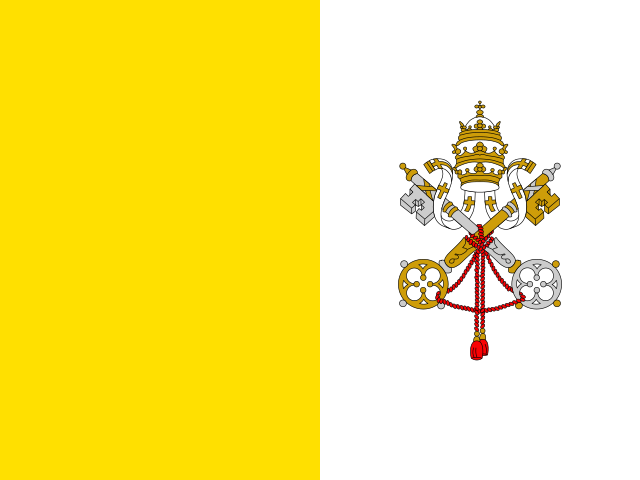 Vatican City Vatican City | Europe | 0.44 km2 |
| 2 |  Monaco Monaco | Europe | 2.08 km2 |
| 3 | 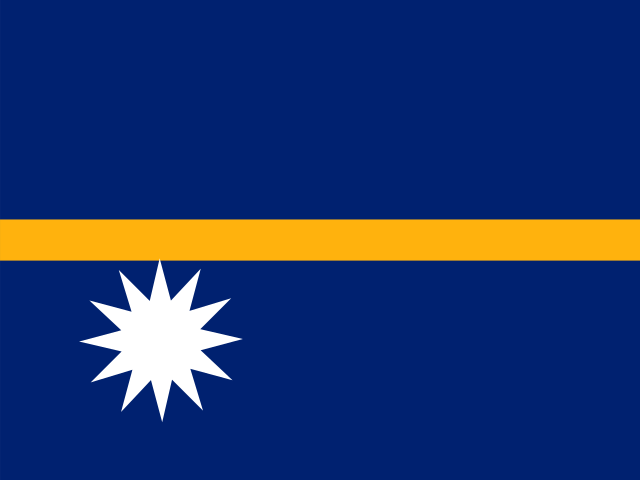 Nauru Nauru | Oceania | 21 km2 |
| 4 | 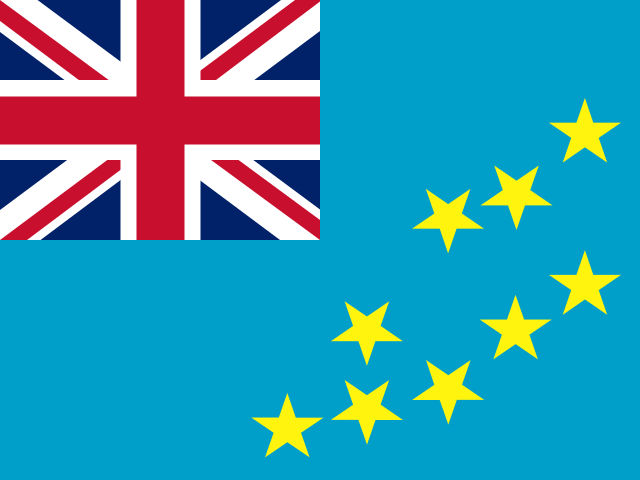 Tuvalu Tuvalu | Oceania | 26 km2 |
| 5 |  San Marino San Marino | Europe | 61 km2 |
| 6 |  Liechtenstein Liechtenstein | Europe | 160 km2 |
| 7 |  Marshall Islands Marshall Islands | Oceania | 181 km2 |
| 8 |  Saint Kitts and Nevis Saint Kitts and Nevis | North America | 261 km2 |
| 9 |  Maldives Maldives | Asia | 298 km2 |
| 10 |  Malta Malta | Europe | 316 km2 |
Two notes on the figures above. Monaco's area here is the one Monaco's own statistics office publishes: IMSEE puts the principality at 208 hectares, or 2.08 square kilometers, a total that now includes the Mareterra district reclaimed from the sea and opened in December 2024. The World Bank's surface area series records Monaco at roughly 75 square kilometers, a long standing anomaly in that one series, and it is not used here. Vatican City's 0.44 square kilometers is the figure the Vatican's own government publishes, though a rounded 0.49 is often quoted elsewhere.
The smallest country on every continent
Vatican City's win is so total that it is worth asking what the smallest country looks like continent by continent, since four of the five answers are far less famous.
| Continent | Smallest country | Area |
|---|---|---|
| Europe | Vatican City | 0.44 km2 |
| Africa |  Seychelles Seychelles | 457 km2 |
| Asia | Maldives | 298 km2 |
| the Americas | Saint Kitts and Nevis | 261 km2 |
| Oceania | Nauru | 21 km2 |
Seychelles, an archipelago of 115 islands off East Africa's coast, is Africa's smallest country by a wide margin, at well under a tenth the size of the next smallest African state. South America has no truly tiny country: its own smallest, Suriname, still covers more than 163,000 square kilometers, larger than Bangladesh, which is why South America never appears on lists like this one.
Smallest by population, not by area
Area and population rank differently once you leave Vatican City, which happens to lead both lists. Tuvalu and Nauru, both Pacific island nations, have fewer residents than a large secondary school, while Monaco, tiny by area, is comparatively crowded, with a higher population density than almost anywhere else on Earth.
| Country | Population | Source and year |
|---|---|---|
| Vatican City | 882 | 2023, Holy See Annuario Pontificio via CIA World Factbook |
| Tuvalu | 9,492 | 2025, World Bank |
| Nauru | 12,025 | 2025, World Bank |
 Palau Palau | 17,663 | 2025, World Bank |
| San Marino | 34,109 | 2025, World Bank |
| Monaco | 38,341 | 2025, World Bank |
Why these countries exist at all
Most of the ten are survivors of a much older map. Vatican City was carved out in 1929 by the Lateran Treaty between Italy and the Holy See, ending decades of dispute over the Pope's temporal authority after Italian unification absorbed the rest of the Papal States. Monaco and San Marino are medieval leftovers, city states that outlasted the empires and kingdoms that once surrounded them through a mix of fortified geography, diplomacy, and treaties that guaranteed their independence in exchange for neutrality. Liechtenstein survived as a buffer state between larger German speaking powers. The Pacific and Caribbean entries on the list, Nauru, Tuvalu, the Marshall Islands, Saint Kitts and Nevis, and Maldives, are almost all former colonies or trust territories that became fully independent states during the wave of decolonization from the 1960s through the 1980s, choosing full statehood over integration with a larger neighbor despite populations in the thousands or tens of thousands.
Quick facts
- Vatican City, at 0.44 square kilometers, is the smallest sovereign state in the world by area and by population.
- Monaco is the second smallest by land area, at 2.08 square kilometers, or 208 hectares, a figure that now includes the Mareterra district reclaimed from the sea.
- Seychelles is the smallest country in Africa, Maldives the smallest in Asia, Saint Kitts and Nevis the smallest in the Americas, and Nauru the smallest in Oceania.
- South America has no microstate: its smallest country, Suriname, is larger than Bangladesh.
- By population, Vatican City again leads, followed by Tuvalu and Nauru, both under 15,000 residents.