Papua New Guinea: map, flag, capital and key facts
Papua New Guinea is a country in Oceania, with about 10.8 million people (2025) and an area of 462,840 square kilometres. Its capital is Port Moresby, and its only land neighbour is Indonesia.
By Team Geography·Last reviewed
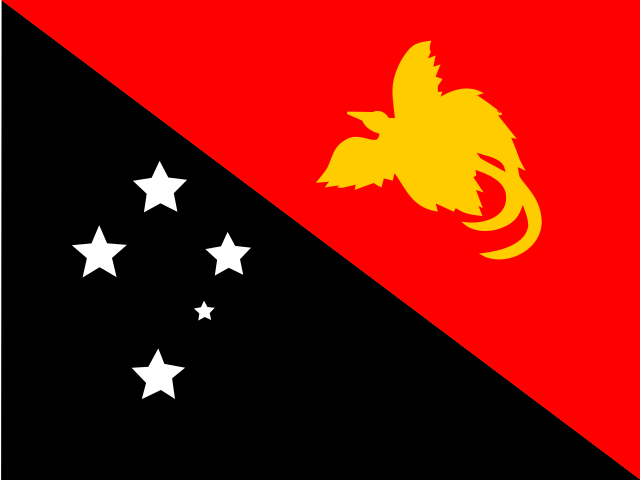
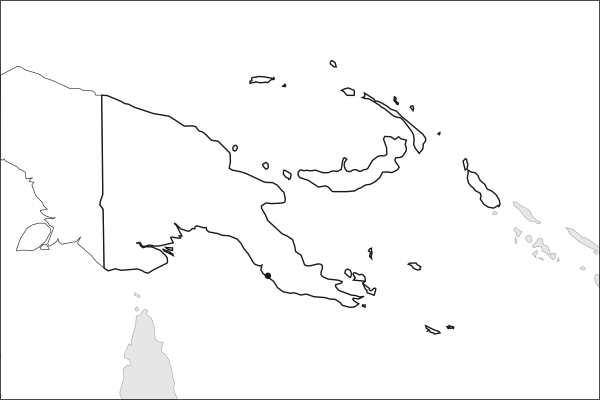
Flag of Papua New GuineaPapua New Guinea in solid, land neighbours outlined, capital marked.
The app teaches each country through short hand written lenses: PLACE for physical geography, STORY for history and identity, NOW for the news, and THREAD for the ties between countries. Here is one of Papua New Guinea's 7, in full.
PLACELens 1 of 7
The most linguistically diverse place on Earth sits on one island
Papua New Guinea occupies the eastern half of New Guinea, the world's second-largest island, plus hundreds of Pacific islands. Its 462,840 square kilometers hold more than 840 languages, the highest density anywhere. The Highlands rise above 4,000 meters along the island's spine, isolating valleys for millennia. Rain forest, swamp, and volcanic chains deepened the isolation. The capital, Port Moresby, sits on the drier southern coast, with no road to most of the country. Australian patrols reached some Highland communities only in the 1930s.
More on 840 languages
PNG has roughly 12 percent of the world's living languages, spoken by a population of about 10 million. Many languages have fewer than 1,000 speakers. Tok Pisin, a creole based on English, German, and Melanesian languages, serves as the national lingua franca.
6 more lenses on Papua New Guinea in the app
STORY Highland cultures that the twentieth century barely reached
STORY Ninety-seven percent of the land belongs to its clans
NOW Gas from the jungle is reshaping a nation's finances
THREAD Australia's most complicated neighbor
NOW The Coral Triangle's least protected corner
PLACE Volcanoes, swamps, and highlands with no roads between them
Titles only. The app brings each lens back on a spaced repetition schedule set by how well you knew it: New, Hazy or Clear.
Compare Papua New Guinea with another country
Opens the country comparison tool with population, area, income and more side by side, every figure dated.
Common questions
What is the capital of Papua New Guinea?
The capital of Papua New Guinea is Port Moresby. Port Moresby lies at about 9.5 degrees south and 147.2 degrees east. Papua New Guinea is in Oceania. It is home to about 10.8 million people. The world capitals quiz on this site tests every capital, and the printable capitals sheets cover each continent.
What is the population of Papua New Guinea?
About 10.8 million people live in Papua New Guinea, according to the World Bank figures for 2025. That makes it the 91st most populous of the 195 countries. With an area of 462,840 square kilometres, that is about 23 people per square kilometre.
What countries border Papua New Guinea?
Papua New Guinea shares land borders with 1 country: Indonesia. The map on this page outlines each of them around Papua New Guinea. The count includes only borders on land, not neighbours across a sea or a lake. Borders here follow Natural Earth at the 1:50 million scale, with Crimea shown as part of Ukraine and Western Sahara as a separate territory.
How big is Papua New Guinea?
Papua New Guinea covers 462,840 square kilometres, or about 178,703 square miles. That makes it the 56th largest of the 195 countries. The figure is total surface area, which includes inland water such as lakes and rivers. Its population of about 10.8 million gives a density of 23 people per square kilometre.
Papua New Guinea is a country in Oceania, with about 10.8 million people (2025) and an area of 462,840 square kilometres. Its capital is Port Moresby, and its only land neighbour is Indonesia.
Capital
Port Moresby
Continent
Oceania
Population
10,762,817 2025, World Bank. 91st of 195.
Area
462,840 km² (178,703 sq mi) World Bank, surface area. 56th largest of 195.
Population density
23 people per km²
Land neighbours
1: Indonesia
Official name
Independent State of Papua New Guinea
UN status
Member state
PLACE · from the Geography app
The most linguistically diverse place on Earth sits on one island
Papua New Guinea occupies the eastern half of New Guinea, the world's second-largest island, plus hundreds of Pacific islands. Its 462,840 square kilometers hold more than 840 languages, the highest density anywhere. The Highlands rise above 4,000 meters along the island's spine, isolating valleys for millennia. Rain forest, swamp, and volcanic chains deepened the isolation. The capital, Port Moresby, sits on the drier southern coast, with no road to most of the country. Australian patrols reached some Highland communities only in the 1930s.
Keep going on your iPhone. Scan for Geography: the world, one country at a time, about five minutes a day. No quizzes and no streaks. playgeography.app/countries/papua-new-guinea/ · Map data: Natural Earth. Figures: World Bank and national sources, as listed on the page.
Geography · Country report
Papua New Guinea
NameDate
Draw the flag
Colour Papua New Guinea on the map, then fill in what you find.
Capital
Continent
Population
Area
Languages
Currency
Neighbours
Landmarks
Rivers or mountains
Three things I learned
1
2
3
One question I still have
?
Keep going on your iPhone. Scan for Geography: the world, one country at a time, about five minutes a day. No quizzes and no streaks. playgeography.app/countries/papua-new-guinea/ · Map data: Natural Earth. Figures: World Bank and national sources, as listed on the page.