Fifteen republics, and the order they left in
The Soviet Union was a union of fifteen constituent republics, each nominally sovereign and, on paper, free to secede. Soviet planners had drawn the borders between them in the 1920s and 1930s, often splitting ethnic groups across more than one republic, and for decades those lines meant almost nothing in daily life. A Ukrainian could move to Kazakhstan, work and retire there without crossing anything that felt like a border.
Between March 1990 and December 1991, that changed for good. One republic at a time, each declared independence, and every administrative line Moscow had drawn became the edge of a new country. The table below gives the order, using the declaration date rather than the date it was recognised, which in several cases came later.
| Republic | Became | Independence declared |
|---|---|---|
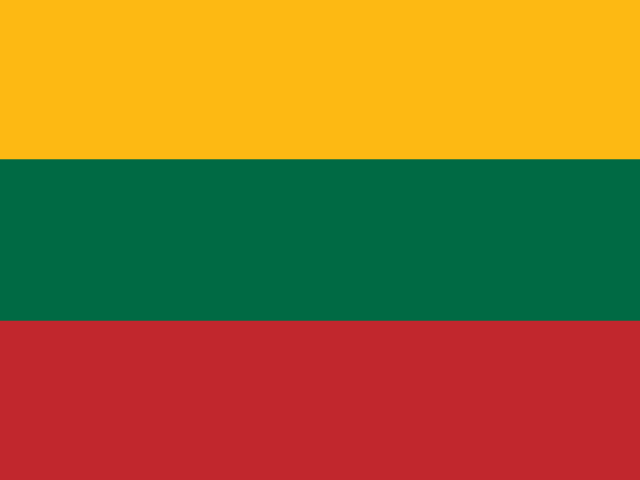 Lithuanian SSR Lithuanian SSR | Lithuania | 11 Mar 1990 |
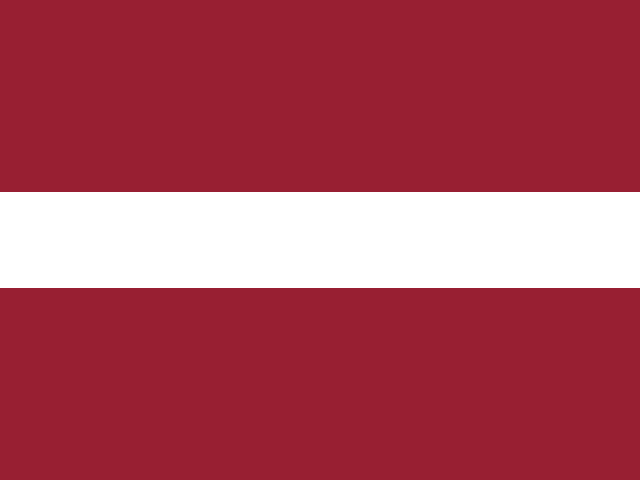 Latvian SSR Latvian SSR | Latvia | 4 May 1990 |
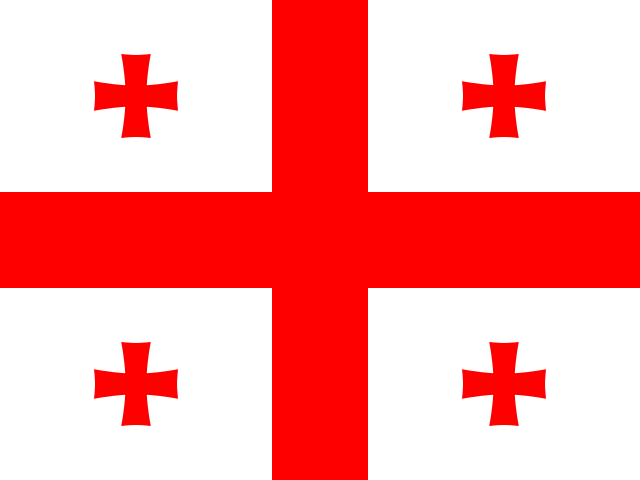 Georgian SSR Georgian SSR | Georgia | 9 Apr 1991 |
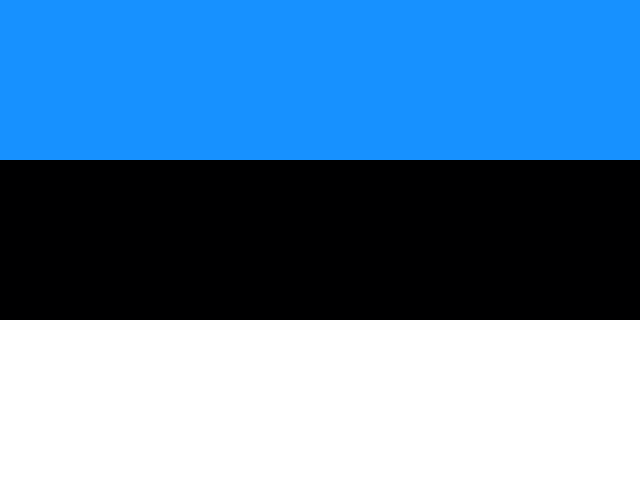 Estonian SSR Estonian SSR | Estonia | 20 Aug 1991 |
 Ukrainian SSR Ukrainian SSR | Ukraine | 24 Aug 1991 |
 Byelorussian SSR Byelorussian SSR | Belarus | 25 Aug 1991 |
 Moldavian SSR Moldavian SSR | Moldova | 27 Aug 1991 |
 Azerbaijan SSR Azerbaijan SSR | Azerbaijan | 30 Aug 1991 |
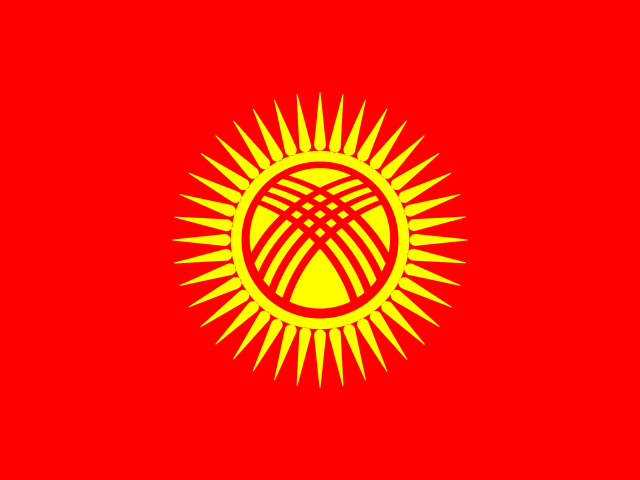 Kirghiz SSR Kirghiz SSR | Kyrgyzstan | 31 Aug 1991 |
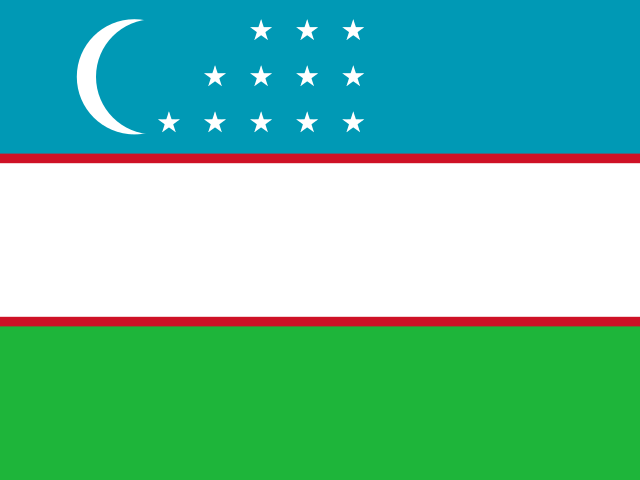 Uzbek SSR Uzbek SSR | Uzbekistan | 31 Aug 1991 |
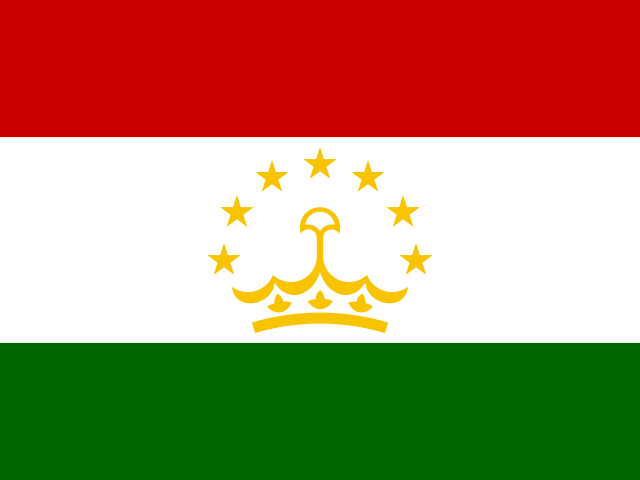 Tajik SSR Tajik SSR | Tajikistan | 9 Sep 1991 |
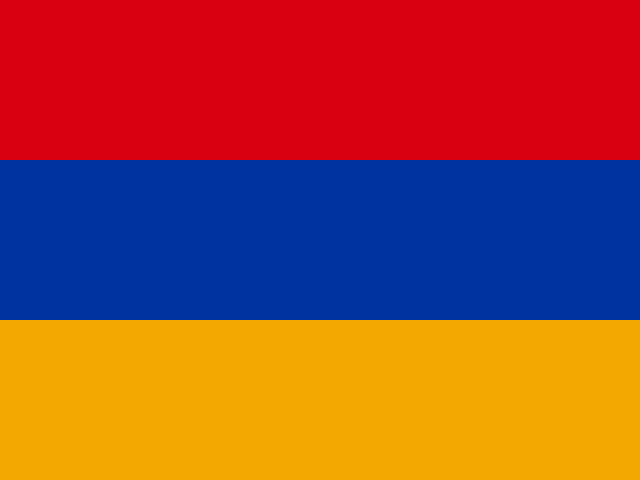 Armenian SSR Armenian SSR | Armenia | 23 Sep 1991 |
 Turkmen SSR Turkmen SSR | Turkmenistan | 27 Oct 1991 |
 Kazakh SSR Kazakh SSR | Kazakhstan | 16 Dec 1991 |
 Russian SFSR Russian SFSR | Russia | 25 Dec 1991* |
*Russia is a special case: rather than seceding, it is the continuator state of the USSR, keeping the UN Security Council seat, and became separate only when the union itself ended on 25 to 26 December 1991. Lithuania's and Latvia's 1990 declarations took effect only after the August 1991 coup below. Dates checked against the Office of the Historian timeline and the individual declarations.
An economy that had stopped delivering
By the early 1980s Soviet growth had slowed to a crawl. Planners rewarded factory output over usefulness, consumer goods and food stayed chronically short, and the military absorbed a huge share of national income. The one part of the economy still earning real money abroad was oil and gas: by 1985, energy exports supplied around three-fifths of the Soviet Union's hard currency income, the money it needed to buy grain and machinery it could not produce itself.
That dependence broke in 1986, when Saudi Arabia stopped propping up prices and the world oil price collapsed from around 27 dollars a barrel to under 10. Soviet hard currency earnings from energy fell from about 13.5 billion dollars in 1985 to 7.9 billion in 1986, a roughly 40 percent drop, just as Gorbachev was raising investment and defence spending. The resulting budget deficit, worsened by a costly anti-alcohol campaign that cut tax revenue, reached more than 10 percent of Soviet GNP by the decade's end.
Glasnost and perestroika meet a nationalities question
Gorbachev became General Secretary in March 1985 already convinced the system needed restructuring, or perestroika. A February 1986 speech paired that with glasnost, openness, a loosening of censorship meant to expose the failures perestroika needed to fix. It worked: people could suddenly say things in public unsayable for decades, and long suppressed grievances about how Soviet borders had carved up nations came into the open too.
The Soviet constitution had always granted each republic, under Article 72, the right to secede, a clause that stayed theoretical for most of Soviet history. Glasnost changed that, giving nationalist movements the tools to organise openly using the constitution the state itself had written.
1989: the Warsaw Pact goes first
The republics were not the first part of the Soviet bloc to break away. In 1989, Poland held round table talks with the banned Solidarity trade union, leading to elections in June that Solidarity swept. Hungary dismantled its border fence with Austria that May, opening a route west for East Germans. East Germany's government collapsed under the weight of citizens leaving, and the Berlin Wall came down on 9 November 1989. By year's end every Warsaw Pact government outside the USSR had fallen or been forced to share power, without Moscow using force to stop it.
The Baltics sing their way out
The clearest demonstration came from the Baltic republics. On 23 August 1989, the fiftieth anniversary of the pact under which the USSR had annexed them in 1940, an estimated two million people formed a human chain 600 kilometres long, from Tallinn through Riga to Vilnius. The Baltic Way was the peak of the Singing Revolution, years of mass gatherings built around banned national songs rather than street violence. Lithuania declared independence first, on 11 March 1990, and Latvia followed in May, though all three had their independence formally recognised only after the August 1991 coup below.
August 1991: the coup that accelerated everything
On 18 to 19 August 1991, hardline officials placed Gorbachev under house arrest at his Crimean dacha and announced an emergency committee had taken power, hours before a treaty was due to loosen the union further. Boris Yeltsin stood on a tank outside the Russian parliament and called for a general strike. The plotters lost their nerve within three days: by 21 August the coup had collapsed, but Gorbachev returned to a country whose republics no longer took him seriously. Estonia declared independence on 20 August and Latvia ended its transition period the next day, and ten more republics followed within four months.
The Belovezha Accords and the Alma-Ata Protocol
On 8 December 1991, the presidents of Russia, Ukraine and Belarus met at a hunting lodge in the Belavezhskaya Pushcha forest, near the Belarusian border with Poland, and signed the Belovezha Accords, declaring that "the USSR, as a subject of international law and a geopolitical reality, ceases its existence," and creating a loose Commonwealth of Independent States. Gorbachev learned of it only after Yeltsin had already called the White House.
Three republics could not dissolve the union alone, so on 21 December 1991 eight more, Armenia, Azerbaijan, Kazakhstan, Kyrgyzstan, Moldova, Tajikistan, Turkmenistan and Uzbekistan, joined them in Alma-Ata to sign the Alma-Ata Protocol, confirming the Commonwealth with eleven members. Georgia and the Baltic states did not join.
Gorbachev's resignation, 25 December 1991
On the evening of 25 December 1991, Gorbachev delivered a ten minute address announcing his resignation as President of the USSR, citing the Commonwealth's creation four days earlier as having already ended the union. Within the hour the Kremlin's Soviet flag was replaced with the Russian tricolour, and the Supreme Soviet recognised the dissolution the next day, closing a union of just under 69 years.
Quick facts
- The Soviet Union existed from 1922 to 1991 and comprised 15 union republics at its end.
- Soviet energy export earnings fell by roughly 40 percent in 1986 alone after the world oil price collapsed.
- The August 1991 coup lasted three days, from 19 to 21 August.
- Eleven of the fifteen republics founded the Commonwealth of Independent States at Alma-Ata on 21 December 1991.