Key facts about Saint Kitts and Nevis
| Capital | Basseterre |
|---|---|
| Continent | North America |
| Region | Central America and the Caribbean |
| Population | 46,922 2025, World Bank. 187th of 195. |
| Area | 260 km² (100 sq mi) World Bank, surface area. 188th largest of 195. |
| Population density | 180 people per km² |
| Land neighbours | None. It has no land borders with another country. |
| UN status | Member state |
| Capital coordinates | 17.30° N, 62.72° W Basseterre, Natural Earth. |
No land borders
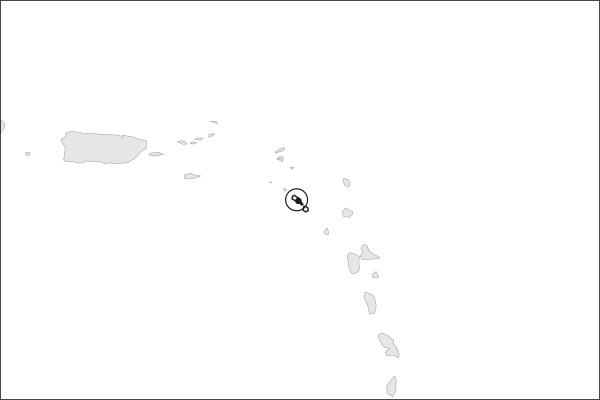
Saint Kitts and Nevis shares no land border with another country. Its nearest neighbours are across the sea, as the map above shows.
From the Geography app
The app teaches each country through short hand written lenses: PLACE for physical geography, STORY for history and identity, NOW for the news, and THREAD for the ties between countries. Here is one of Saint Kitts and Nevis's 5, in full.
Two volcanoes and three kilometers of water
Saint Kitts is a 168 square kilometer volcanic cone with a long southeastern tail; Nevis is a near-circle a little smaller, and both fall steeply into the Caribbean Sea on their leeward flanks. Mount Liamuiga rises to 1,156 meters, dormant for some sixteen centuries. Nevis Peak reaches 985 meters. Between them lies The Narrows, a shallow channel three kilometers wide. The two islands cover 261 square kilometers and hold about 54,000 people, the smallest sovereign state in the Western Hemisphere.
More on The Narrows
The Narrows is shallow enough that the two islands share a submarine platform and were joined during ice ages, when sea levels stood lower. It takes a ferry about forty minutes to cross. That short gap is the whole geography of the federation's politics: near enough to be one country, separate enough that Nevis has never quite agreed to be.
4 more lenses on Saint Kitts and Nevis in the app
Titles only. The app brings each lens back on a spaced repetition schedule set by how well you knew it: New, Hazy or Clear.
Compare Saint Kitts and Nevis with another country
Opens the country comparison tool with population, area, income and more side by side, every figure dated.