Cuba is a country in North America, in Central America and the Caribbean, with about 10.9 million people (2025) and an area of 109,880 square kilometres. Its capital is Havana, and it has no land borders.
By Team Geography·Last reviewed
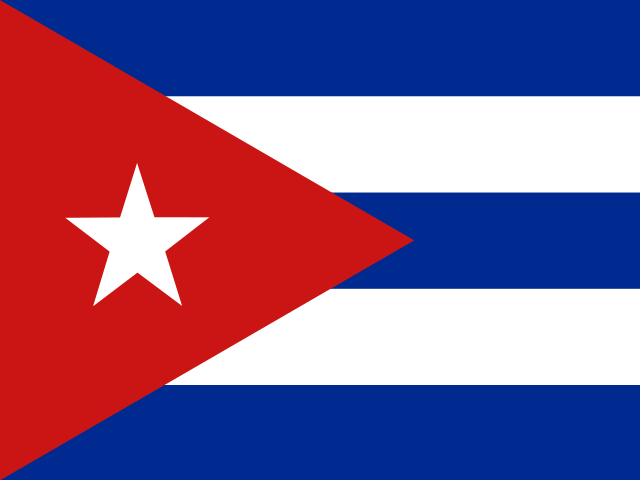
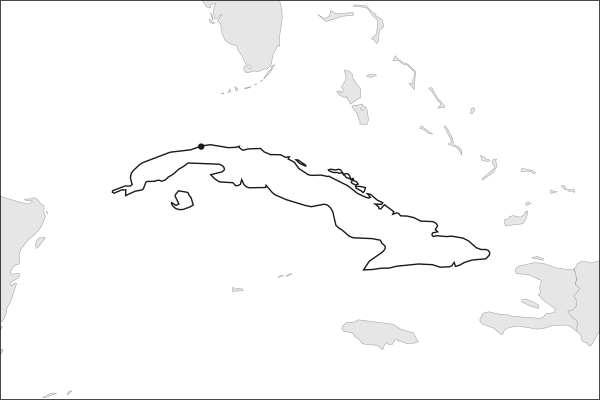
Flag of CubaCuba in solid, land neighbours outlined, capital marked.
109,880 km² (42,425 sq mi) World Bank, surface area. 105th largest of 195.
Population density
100 people per km²
Land neighbours
None. It has no land borders with another country.
Official name
Republic of Cuba
UN status
Member state
Capital coordinates
23.13° N, 82.37° W Havana, Natural Earth.
No land borders
Cuba shares no land border with another country. Its nearest neighbours are across the sea, as the map above shows.
From the Geography app
The app teaches each country through short hand written lenses: PLACE for physical geography, STORY for history and identity, NOW for the news, and THREAD for the ties between countries. Here is one of Cuba's 5, in full.
PLACELens 1 of 5
Cuba sits at the mouth of the Gulf of Mexico, 150 km from Florida
Cuba is the Caribbean's largest island, stretching roughly 1,250 km from end to end. It commands the entrance to the Gulf of Mexico, with the Strait of Florida to the north and the Yucatán Channel to the west. That position made it strategically invaluable to Spain for centuries, to the US after 1898, and to the Soviet Union during the Cold War. Cuba's geography ensures it cannot be ignored by whoever controls the Gulf.
More on Strait of Florida
Only about 150 km separate Havana from Key West. That proximity has shaped US-Cuba relations for over a century, from the Spanish-American War to the Mariel boatlift to today's migration crossings.
4 more lenses on Cuba in the app
STORY The Revolution froze Cuba in a political model most of the hemisphere moved past
STORY Cuban culture punches far above the island's weight
NOW Cuba's economic collapse is hollowing out the island
THREAD Cuba was the Cold War's most dangerous flashpoint
Titles only. The app brings each lens back on a spaced repetition schedule set by how well you knew it: New, Hazy or Clear.
Compare Cuba with another country
Opens the country comparison tool with population, area, income and more side by side, every figure dated.
Common questions
What is the capital of Cuba?
The capital of Cuba is Havana. Havana lies at about 23.1 degrees north and 82.4 degrees west. Cuba is in North America, in the region often called Central America and the Caribbean. It is home to about 10.9 million people.
What is the population of Cuba?
About 10.9 million people live in Cuba, according to the World Bank figures for 2025. That makes it the 87th most populous of the 195 countries. With an area of 109,880 square kilometres, that is about 100 people per square kilometre.
What countries border Cuba?
None. Cuba has no land borders with any other country. It is surrounded by sea, so every neighbour of Cuba is across the water. It lies in North America, in the region often called Central America and the Caribbean. Its area is 109,880 square kilometres, and about 10.9 million people live there.
How big is Cuba?
Cuba covers 109,880 square kilometres, or about 42,425 square miles. That makes it the 105th largest of the 195 countries. The figure is total surface area, which includes inland water such as lakes and rivers. Its population of about 10.9 million gives a density of 100 people per square kilometre.
Cuba is a country in North America, in Central America and the Caribbean, with about 10.9 million people (2025) and an area of 109,880 square kilometres. Its capital is Havana, and it has no land borders.
Capital
Havana
Continent
North America
Region
Central America and the Caribbean
Population
10,937,203 2025, World Bank. 87th of 195.
Area
109,880 km² (42,425 sq mi) World Bank, surface area. 105th largest of 195.
Population density
100 people per km²
Land neighbours
None. It has no land borders with another country.
Official name
Republic of Cuba
UN status
Member state
PLACE · from the Geography app
Cuba sits at the mouth of the Gulf of Mexico, 150 km from Florida
Cuba is the Caribbean's largest island, stretching roughly 1,250 km from end to end. It commands the entrance to the Gulf of Mexico, with the Strait of Florida to the north and the Yucatán Channel to the west. That position made it strategically invaluable to Spain for centuries, to the US after 1898, and to the Soviet Union during the Cold War. Cuba's geography ensures it cannot be ignored by whoever controls the Gulf.
Keep going on your iPhone. Scan for Geography: the world, one country at a time, about five minutes a day. No quizzes and no streaks. playgeography.app/countries/cuba/ · Map data: Natural Earth. Figures: World Bank and national sources, as listed on the page.
Geography · Country report
Cuba
NameDate
Draw the flag
Colour Cuba on the map, then fill in what you find.
Capital
Continent
Population
Area
Languages
Currency
Neighbours
Landmarks
Rivers or mountains
Three things I learned
1
2
3
One question I still have
?
Keep going on your iPhone. Scan for Geography: the world, one country at a time, about five minutes a day. No quizzes and no streaks. playgeography.app/countries/cuba/ · Map data: Natural Earth. Figures: World Bank and national sources, as listed on the page.