Key facts about Iceland
| Capital | Reykjavik |
|---|---|
| Continent | Europe |
| Region | Scandinavia and the Nordic countries |
| Population | 392,404 2025, World Bank. 172nd of 195. |
| Area | 103,000 km² (39,769 sq mi) World Bank, surface area. 107th largest of 195. |
| Population density | 3.8 people per km² |
| Land neighbours | None. It has no land borders with another country. |
| Official name | Republic of Iceland |
| UN status | Member state |
| Capital coordinates | 64.15° N, 21.95° W Reykjavik, Natural Earth. |
No land borders
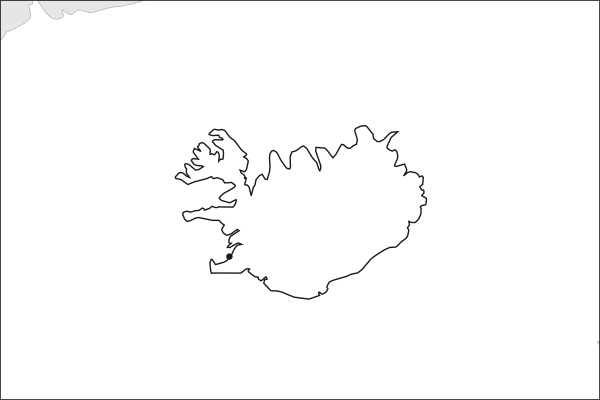
Iceland shares no land border with another country. Its nearest neighbours are across the sea, as the map above shows.
From the Geography app
The app teaches each country through short hand written lenses: PLACE for physical geography, STORY for history and identity, NOW for the news, and THREAD for the ties between countries. Here is one of Iceland's 6, in full.
An island on the seam of two plates
Iceland sits astride the Mid-Atlantic Ridge, the divergent boundary where the North American and Eurasian plates pull apart at roughly two centimeters a year. That seam makes the island one of the most volcanically active places on Earth, with over 30 active volcanic systems. Vatnajokull, Europe's largest glacier by volume, covers 7,900 square kilometers in the southeast and hides several active volcanoes under its ice cap. Fire and ice together produce lava fields, geothermal springs, glacial rivers, and black sand beaches.
More on Mid-Atlantic Ridge
The ridge runs 16,000 kilometers from the Arctic to the South Atlantic, but Iceland is one of the few places where it rises above sea level. The rift zone crossing Iceland produces frequent eruptions, including the 2010 Eyjafjallajokull eruption that disrupted European air traffic for weeks and the 2023 to 2024 Reykjanes Peninsula eruptions that threatened the town of Grindavik.
5 more lenses on Iceland in the app
Titles only. The app brings each lens back on a spaced repetition schedule set by how well you knew it: New, Hazy or Clear.
Compare Iceland with another country
Opens the country comparison tool with population, area, income and more side by side, every figure dated.