Greece is a country in Europe, in The Balkans, with about 10.4 million people (2025) and an area of 131,960 square kilometres. Its capital is Athens, and it shares land borders with 4 countries.
By Team Geography·Last reviewed
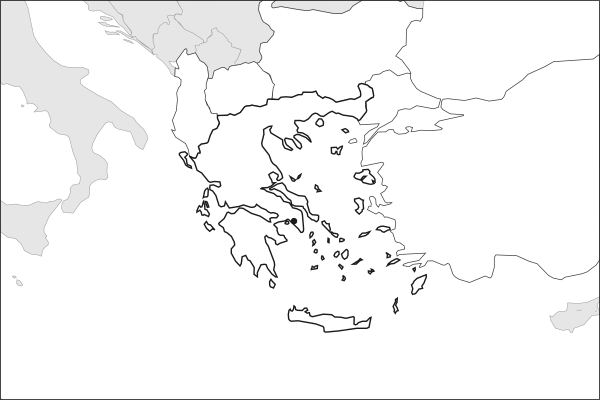
Flag of GreeceGreece in solid, land neighbours outlined, capital marked.
The app teaches each country through short hand written lenses: PLACE for physical geography, STORY for history and identity, NOW for the news, and THREAD for the ties between countries. Here is one of Greece's 6, in full.
PLACELens 1 of 6
Greece commands the eastern Mediterranean's chokepoints
Greece is not one landmass but a fractured geography of peninsulas and roughly 6,000 islands, of which about 200 are inhabited. The Aegean Sea, studded with Greek islands, sits between Europe and Türkiye. That position makes Greece the EU's southeastern gatekeeper, controlling sea lanes, managing migration routes, and watching Turkish naval movements from islands sometimes just a few kilometers off the Anatolian coast.
More on roughly 6,000 islands
Greece has more islands than any other Mediterranean country. The largest, Crete, is the fifth-largest island in the Mediterranean and has been strategically significant since the Bronze Age.
5 more lenses on Greece in the app
STORY Ancient Athens invented the vocabulary the modern world still borrows
STORY The debt crisis reshaped Greece and tested the eurozone's solidarity
NOW Greece emerged from its lost decade with the EU's strongest growth
THREAD Greece and Türkiye share a border, NATO membership, and centuries of mutual suspicion
THREAD One fifth of world tonnage answers to Athens
Titles only. The app brings each lens back on a spaced repetition schedule set by how well you knew it: New, Hazy or Clear.
Compare Greece with another country
Opens the country comparison tool with population, area, income and more side by side, every figure dated.
Common questions
What is the capital of Greece?
The capital of Greece is Athens. Athens lies at about 38.0 degrees north and 23.7 degrees east. Greece is in Europe, in the region often called The Balkans. It is home to about 10.4 million people. The world capitals quiz on this site tests every capital, and the printable capitals sheets cover each continent.
What is the population of Greece?
About 10.4 million people live in Greece, according to the World Bank figures for 2025. That makes it the 93rd most populous of the 195 countries. With an area of 131,960 square kilometres, that is about 79 people per square kilometre.
What countries border Greece?
Greece shares land borders with 4 countries: Albania, Bulgaria, North Macedonia and Türkiye. The map on this page outlines each of them around Greece. The count includes only borders on land, not neighbours across a sea or a lake. Borders here follow Natural Earth at the 1:50 million scale, with Crimea shown as part of Ukraine and Western Sahara as a separate territory.
How big is Greece?
Greece covers 131,960 square kilometres, or about 50,950 square miles. That makes it the 96th largest of the 195 countries. The figure is total surface area, which includes inland water such as lakes and rivers. Its population of about 10.4 million gives a density of 79 people per square kilometre.
Greece is a country in Europe, in The Balkans, with about 10.4 million people (2025) and an area of 131,960 square kilometres. Its capital is Athens, and it shares land borders with 4 countries.
Capital
Athens
Continent
Europe
Region
The Balkans
Population
10,413,962 2025, World Bank. 93rd of 195.
Area
131,960 km² (50,950 sq mi) World Bank, surface area. 96th largest of 195.
Population density
79 people per km²
Land neighbours
4: Albania, Bulgaria, North Macedonia, Türkiye
Official name
Hellenic Republic
UN status
Member state
PLACE · from the Geography app
Greece commands the eastern Mediterranean's chokepoints
Greece is not one landmass but a fractured geography of peninsulas and roughly 6,000 islands, of which about 200 are inhabited. The Aegean Sea, studded with Greek islands, sits between Europe and Türkiye. That position makes Greece the EU's southeastern gatekeeper, controlling sea lanes, managing migration routes, and watching Turkish naval movements from islands sometimes just a few kilometers off the Anatolian coast.
Keep going on your iPhone. Scan for Geography: the world, one country at a time, about five minutes a day. No quizzes and no streaks. playgeography.app/countries/greece/ · Map data: Natural Earth. Figures: World Bank and national sources, as listed on the page.
Geography · Country report
Greece
NameDate
Draw the flag
Colour Greece on the map, then fill in what you find.
Capital
Continent
Population
Area
Languages
Currency
Neighbours
Landmarks
Rivers or mountains
Three things I learned
1
2
3
One question I still have
?
Keep going on your iPhone. Scan for Geography: the world, one country at a time, about five minutes a day. No quizzes and no streaks. playgeography.app/countries/greece/ · Map data: Natural Earth. Figures: World Bank and national sources, as listed on the page.